AI use policy templatefor UK firms

What staff may do with AI, in plain English.
Most firms already have staff using AI tools, approved or not. This policy sets out which tools are allowed, what data can go into them, and who stays accountable. It is written for UK GDPR and the ICO's guidance on AI, and short enough that people will read it.
Word · Ready to adapt · Free, no sign-up
- 14 sections
- Placeholders highlighted
- UK GDPR and ICO references
This template is a starting point, not legal advice. Adapt it to how your firm works, and have it reviewed by your data protection lead or legal adviser before you adopt it. Text in [square brackets] is for you to fill in or delete.
Text in [square brackets] is for you to fill in. The Word file highlights every one, so nothing gets missed.
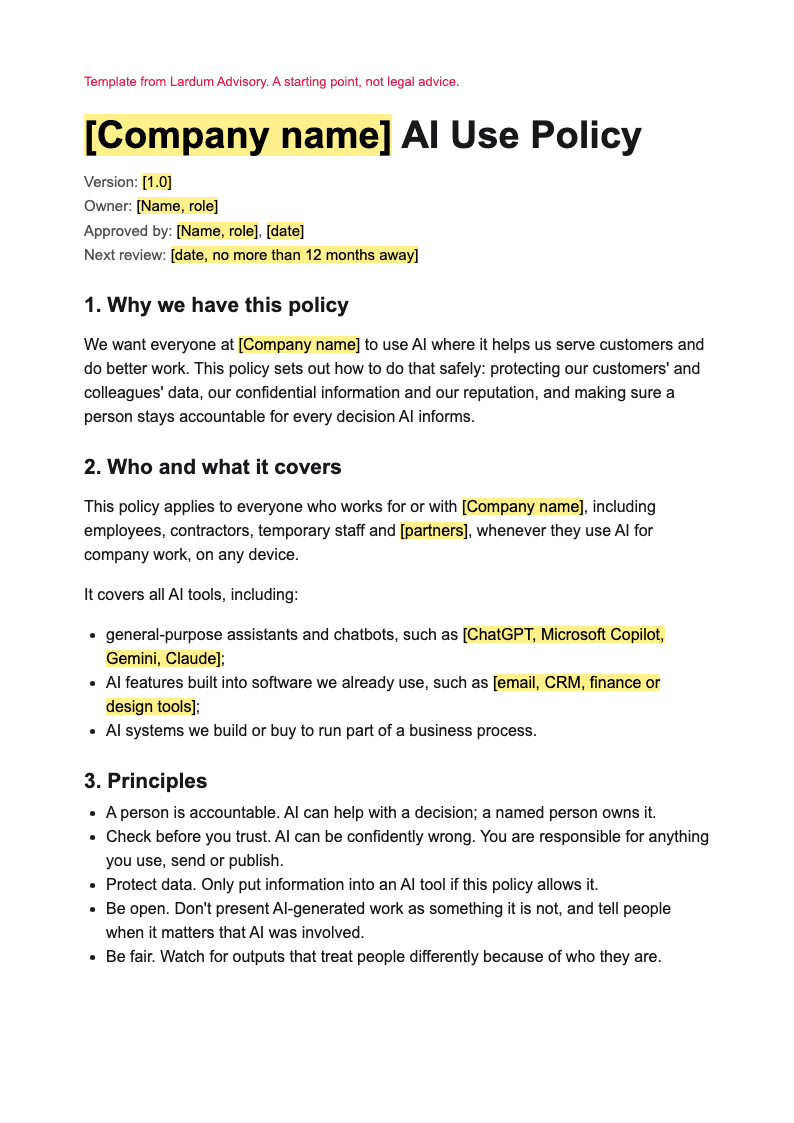
[Company name] AI Use Policy
- Version: [1.0]
- Owner: [Name, role]
- Approved by: [Name, role], [date]
- Next review: [date, no more than 12 months away]
1. Why we have this policy
We want everyone at [Company name] to use AI where it helps us serve customers and do better work. This policy sets out how to do that safely: protecting our customers' and colleagues' data, our confidential information and our reputation, and making sure a person stays accountable for every decision AI informs.
2. Who and what it covers
This policy applies to everyone who works for or with [Company name], including employees, contractors, temporary staff and [partners], whenever they use AI for company work, on any device.
It covers all AI tools, including:
- general-purpose assistants and chatbots, such as [ChatGPT, Microsoft Copilot, Gemini, Claude];
- AI features built into software we already use, such as [email, CRM, finance or design tools];
- AI systems we build or buy to run part of a business process.
3. Principles
- A person is accountable. AI can help with a decision; a named person owns it.
- Check before you trust. AI can be confidently wrong. You are responsible for anything you use, send or publish.
- Protect data. Only put information into an AI tool if this policy allows it.
- Be open. Don't present AI-generated work as something it is not, and tell people when it matters that AI was involved.
- Be fair. Watch for outputs that treat people differently because of who they are.
4. Approved tools
Use only the AI tools on the approved list at [location, e.g. intranet page]. Approved tools have been checked for where data is stored, how long it is kept and whether it is used to train the supplier's models.
- Use your company account, not a personal account, for any company work.
- To request a new tool, contact [IT / the AI policy owner]. Don't sign up for AI tools with your work email without approval.
- Free or consumer versions of tools are not approved unless the list says so.
5. What you can put into AI tools
Before you paste, upload or connect anything, check the table below.
- Public information (published on our website, press releases): any approved tool.
- Internal information (internal processes, general business documents): approved tools only.
- Confidential information (contracts, financials, pricing, strategy, client work): only tools approved for confidential data, which are [list].
- Personal data (anything that identifies a person, including customers and colleagues): only where a tool is approved for that purpose and section 6 is followed.
- Special category data (health, ethnicity, religion, sexual orientation, trade union membership, biometrics) and criminal records data: never, unless the [Data Protection Officer / lead] has approved the specific use in writing.
- Passwords, keys and access credentials: never.
6. Personal data
Using AI on personal data must follow UK GDPR and the Data Protection Act 2018, as it does everywhere else. In particular:
- there must be a lawful basis for the use, and people must be told about it in our privacy notices;
- use only the personal data the task needs;
- a data protection impact assessment (DPIA) must be completed before any new AI use that is likely to be high risk to people, such as profiling, monitoring staff or making decisions about individuals;
- where AI is used to make decisions about people with legal or similarly significant effects (for example on recruitment, credit or pay), a person must review each decision meaningfully before it takes effect, and the person affected must be able to ask for an explanation and challenge it. Check the current rules with [the Data Protection Officer / lead] before starting any such use.
Requests from people to see, correct or delete their data cover data processed by AI tools too. Send them to [contact] as usual.
7. Checking AI output
- Check facts, figures, names, quotes and references against a reliable source before you rely on them.
- Read anything AI drafts before it goes to a customer, supplier or colleague, and edit it so it says what you mean.
- Have code produced by AI reviewed and tested to the same standard as any other code.
- If an AI output looks biased, unsafe or wrong in a way that could repeat, report it under section 11.
8. Being open about AI use
- Tell customers when they are dealing with an AI system rather than a person, for example a chatbot.
- Follow any client contract terms on the use of AI in work for them. If in doubt, ask [contact] before using AI on client work.
- Don't use AI to impersonate a real person or to create misleading images, audio or video.
9. Confidentiality and intellectual property
- Our confidentiality obligations to clients, suppliers and colleagues apply in full when using AI.
- Don't put third-party material into AI tools where the licence or contract forbids it.
- Be aware that AI output may resemble existing copyrighted work. Check anything you plan to publish or sell.
10. AI in our business processes
Any AI system that takes or informs decisions as part of a business process (not just an individual's own productivity) must, before go-live:
- have one named accountable owner;
- be recorded in the AI register at [location], with its risk level, autonomy level, where a person signs off and how its outputs are checked;
- have a baseline measure, so its results can be shown;
- have a DPIA where personal data is involved and the use is likely to be high risk;
- be checked for security in line with [IT security policy], following the NCSC's guidance on secure AI system development where we build our own.
The owner reviews the system at least [quarterly] and whenever the workflow, the model or the supplier changes.
11. Reporting problems
Report straight away to [contact or channel] if:
- you have put information into an AI tool that this policy does not allow;
- an AI tool has produced output that is harmful, discriminatory or seriously wrong and has been, or could be, used;
- you suspect an AI tool or supplier has exposed our data.
A possible personal data breach must be reported within [24 hours] so that we can meet the 72-hour deadline for telling the ICO where that is required. Reporting a mistake promptly will be treated as the right thing to do.
12. Training and support
Everyone covered by this policy will complete [AI awareness training] when they join and [annually]. Questions about this policy go to [contact].
13. Breaking this policy
Breaches of this policy will be handled under [the disciplinary policy / contractor terms]. Deliberately or repeatedly putting restricted data into unapproved tools will be treated as serious.
14. Ownership and review
[Role] owns this policy and reviews it at least every 12 months, or sooner if the law, the ICO's guidance or our use of AI changes significantly.
Further reading
- ICO: Guidance on AI and data protection
- ICO and The Alan Turing Institute: Explaining decisions made with AI
- ICO: Data protection impact assessments
- NCSC: Guidelines for secure AI system development
Making it work
A policy tells staff what they may do. It doesn't decide who owns each AI workflow or how its outputs are checked: that is what the AI governance template is for. Section 10 of the policy assumes you keep that register.