AI governanceand ownership template
Who owns each AI decision, where a person signs off, and how it is checked.
AI never crosses into the operation when nobody owns it. This register gives every decision AI takes or informs a named owner, a sign-off point and a schedule of checks, sized for a mid-market firm rather than a bank.
Excel · Ready to fill in · Free, no sign-up
- 5 sheets
- 3 worked examples
- Drop-downs for risk and autonomy
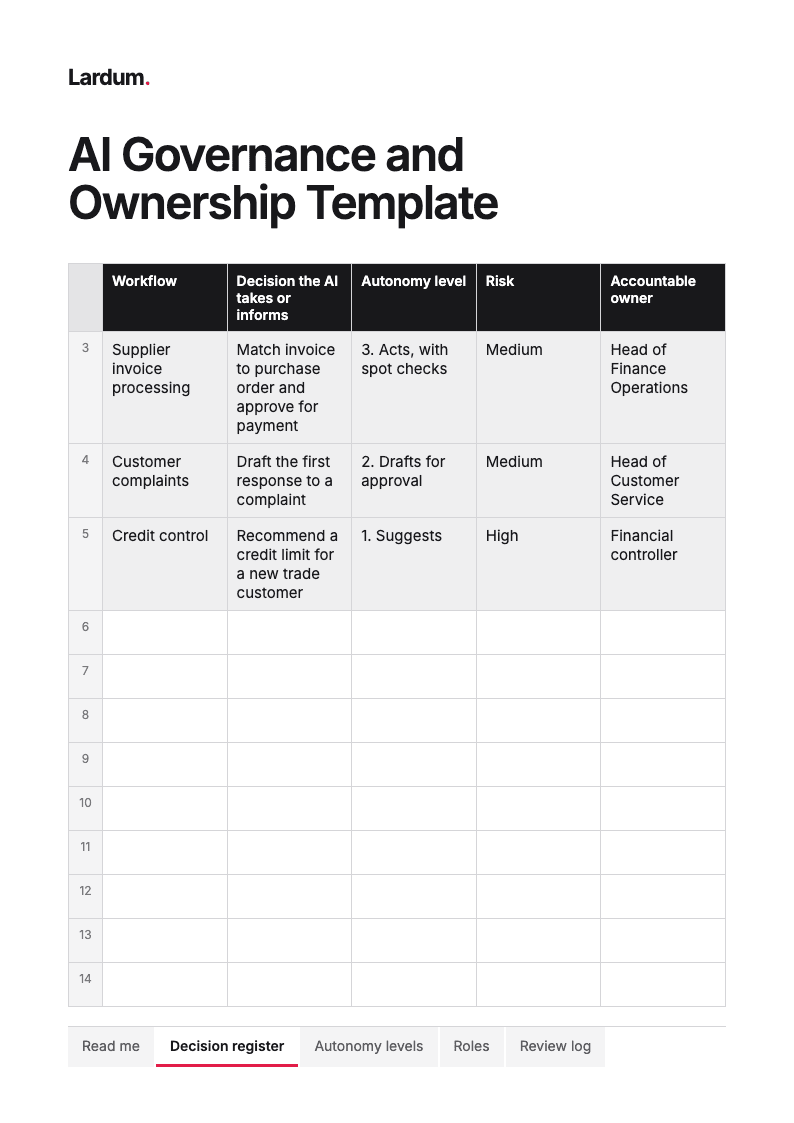
Five sheets: how to use it, the decision register with three worked examples, autonomy and risk levels, roles, and a review log. Works in Excel, Google Sheets and Numbers.
The register, filled in
One row per decision, not per tool. These are the three worked examples in the workbook, a low, a medium and a high stakes decision. Seventeen columns in the file; the eight that matter most are here.
| Workflow | Decision the AI takes or informs | Autonomy | Risk | Accountable owner | Where a person signs off | How it's checked | Baseline |
|---|---|---|---|---|---|---|---|
| Supplier invoice processing | Match invoice to purchase order and approve for payment | 3. Acts, with spot checks | Medium | Head of Finance Operations | Any invoice over £10,000, or any mismatch over 2% | 20 approved invoices sampled at random | 3.5 days from receipt to approval |
| Customer complaints | Draft the first response to a complaint | 2. Drafts for approval | Medium | Head of Customer Service | An agent approves every draft before it is sent | Agent edits tracked; 10 sent replies reviewed by the team lead | 2 days to first response |
| Credit control | Recommend a credit limit for a new trade customer | 1. Suggests | High | Financial controller | The analyst sets every limit; the AI recommendation is advisory | Every recommendation compared with the final decision | Limits set in 4 days; 3% of accounts in arrears at 90 days |
How much may the AI do alone?
Rate the risk of a wrong answer first. Then allow no more autonomy than the row permits. Most first workflows belong at level 2 or 3.
| Risk of a wrong answer | 1. SuggestsThe AI offers options or a recommendation. A person decides and acts. | 2. Drafts for approvalThe AI prepares the output. A person checks and approves every one before it goes out. | 3. Acts, with spot checksThe AI acts on its own within set limits. A person reviews a sample on a fixed schedule. | 4. Acts aloneThe AI acts on its own. People see exceptions, alerts and a monthly report. | Minimum controls |
|---|---|---|---|---|---|
| LowA wrong answer is easy to spot and cheap to reverse. No personal data, customers or money directly affected. | Allowed | Allowed | Allowed | Allowed, the limit | Monthly report to the owner. Exceptions flagged. |
| MediumA wrong answer costs time or money, or reaches a customer, but can be put right. | Allowed | Allowed | Allowed, the limit | Not allowed | Weekly sample checked by a named person. Thresholds that send cases to a person. |
| HighA wrong answer affects someone's rights, money, health, employment or credit, or breaks a legal duty. | Allowed | Allowed, the limit | Not allowed | Not allowed | A person approves every output. Data protection impact assessment completed. Decisions explained on request. |
How to use it
- List every workflow where AI takes or informs a decision, including tools staff use on their own. One row per decision.
- Give each row one accountable owner. If nobody will put their name to it, the AI should not be making that decision yet.
- Set the risk level first, then choose an autonomy level no higher than the sign-off matrix allows.
- Write down where a person signs off and how outputs are checked, in enough detail that someone new could do it.
- Record a baseline before the AI goes in, and the same measure afterwards. This is how you show the return.
- Review the register every quarter, and whenever a workflow, a model or a supplier changes.
Roles: a RACI for AI decisions
| Role | RACI | What they do |
|---|---|---|
| Accountable owner | A | One named person per workflow. Answers for its results, approves changes, and can switch the AI off. |
| Responsible operator | R | Runs the workflow day to day, carries out the checks and reports problems. |
| Consulted | C | Typically data protection, IT security, legal or the data owner. Asked before a change, not after. |
| Informed | I | Teams and leaders affected by the workflow. Told about changes and incidents. |
Where this fits
A register is only useful if the workflows in it have been redesigned and have a baseline. Pair it with the AI use policy template, which tells staff what they may do with AI tools, and the rollout checklist, which covers the rest of a rollout. If you want to know how ready you are overall, take the readiness scorecard.